ResolveIQ: Technology Strategy That Starts With the Business, Not the Software
Most contractors do not have a software problem. They have an unresolved business problem that software was asked to cover. ResolveIQ built its advisory practice around that distinction, and Cellara built the presence that explains it.
There is a pattern in construction and contracting that almost every operator recognizes. A company buys a platform to fix a problem. Six months later the problem is still there, the platform is half adopted, and the crew has quietly gone back to the group text, the spreadsheet, and the whiteboard in the trailer.
The instinct is to blame the software. The more useful read is that the business never defined the problem precisely enough for any software to solve it.
ResolveIQ built its practice on that distinction. It is a technology advisory firm for construction and general contracting companies, with additional capability in healthcare operations, and it starts every engagement with the business question rather than the product demo.
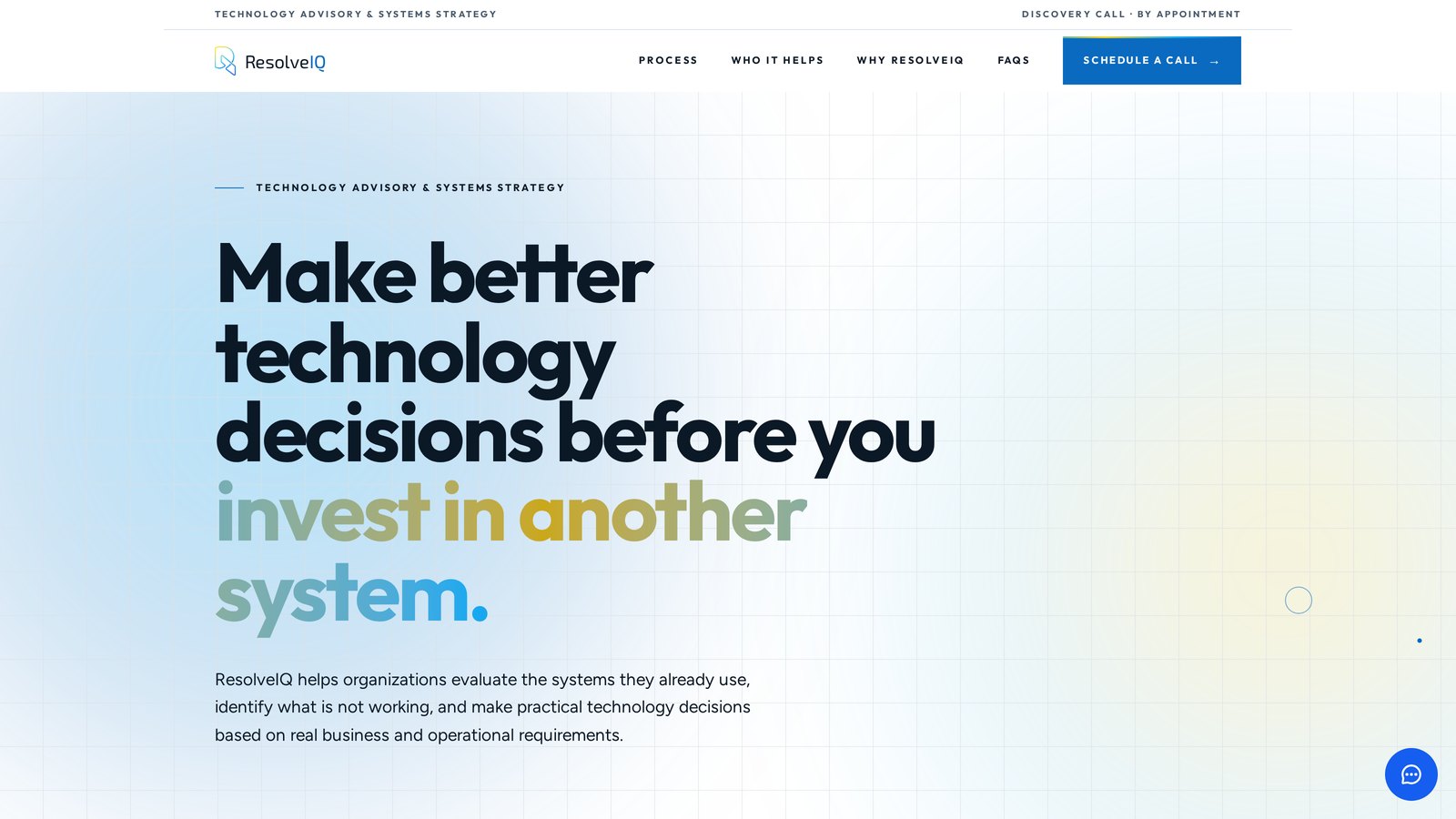
Cellara Growth Co designed and developed the ResolveIQ web presence. This article covers both halves of that work: what ResolveIQ actually does for contractors, and how the presence was built so a serious buyer understands the offer before the first call.
Why Construction Technology Fails So Often
Construction is one of the harder environments in which to introduce new technology, and the reasons are structural rather than cultural.
- Work happens in the field, not at a desk, so any tool that assumes a stable seat and a stable connection loses adoption immediately.
- A single project touches estimating, scheduling, procurement, subcontractors, field crews, change orders, compliance, and billing, so the data has to survive many handoffs.
- Margins are decided by exceptions. Change orders, delays, rework, and material swings are where money is made or lost, and those are exactly the events most systems record last.
- Turnover and subcontracted labor mean the process cannot depend on one person remembering how the process works.
- Buying decisions are often made under time pressure during a busy season, which is the worst moment to evaluate anything carefully.
None of that is solved by a better feature list. It is solved by deciding, in advance and in writing, what the business needs the technology to do, who owns each step, and what a good outcome looks like.
That is advisory work. It happens before procurement, and skipping it is what turns a reasonable platform into an expensive shelf item.
The ResolveIQ Position: Business First, Technology Second
ResolveIQ is not a reseller and it is not an implementation shop chasing license revenue. Its value sits earlier in the sequence, at the point where the business decides what problem it is actually solving.
That ordering matters more than it sounds. When technology leads, the company adapts its operation to the tool and inherits whatever assumptions the vendor built in. When the business leads, the operation is defined first and the tool is selected to serve it. The second path is slower for about two weeks and faster for the following two years.
For a contractor, business-first advisory usually means answering questions that have nothing to do with software: which projects are actually profitable, where information stops moving between the office and the field, which approvals create delay, and what the company would need to see weekly to make better calls.
Only after those answers exist does a platform decision become straightforward, because the requirements are no longer a wish list. They are a specification.
The Three-Step Method
ResolveIQ works through a defined sequence rather than an open-ended engagement. It is published plainly on the firm's site, and the structure is the offer.
- 01
Clarify the Business Need
Establish what the company is actually trying to change, in operational terms. Where work stalls, which handoffs break, what the cost of the current process is, and what success would look like if nothing about the software changed at all.
OutcomeA written problem definition the leadership team agrees on before any tool is discussed.
- 02
Align the Technology Strategy
Map the defined need to an approach: what systems are involved, what integrates with what, what stays manual on purpose, what sequence the work happens in, and what the business can absorb without stopping production.
OutcomeA strategy that fits the operation and the calendar, not a platform selected on features alone.
- 03
Implement with Confidence
Execute against that plan with defined ownership, so the company is not left holding a license and a login. Confidence here is a technical outcome. It comes from knowing the plan was tested against how the business actually runs.
OutcomeAdoption that survives the busy season, because the process was designed around the field rather than around the interface.
The full method, including the questions ResolveIQ works through in each phase, is documented on the ResolveIQ website.
What the Presence Had to Accomplish
Advisory is a harder thing to sell online than a product. A product can be shown. Advisory has to be made legible, because the buyer is evaluating judgment before they have experienced any of it.
That put a specific set of demands on the build. The site could not read as a brochure, and it could not hide the method behind a contact form.
- State the position in the first screen, so an owner knows within seconds whether this firm is for them.
- Publish the method rather than gate it, because a defined process is the strongest proof an advisory firm has.
- Name who the work is for, so the wrong-fit visitor self-selects out and the right-fit visitor recognizes themselves.
- Answer the obvious objections in public, including cost, timing, and what happens if the company has already bought the wrong tool.
- Give one clear next step that matches the sales motion, which for advisory is a conversation rather than a checkout.
How It Was Built
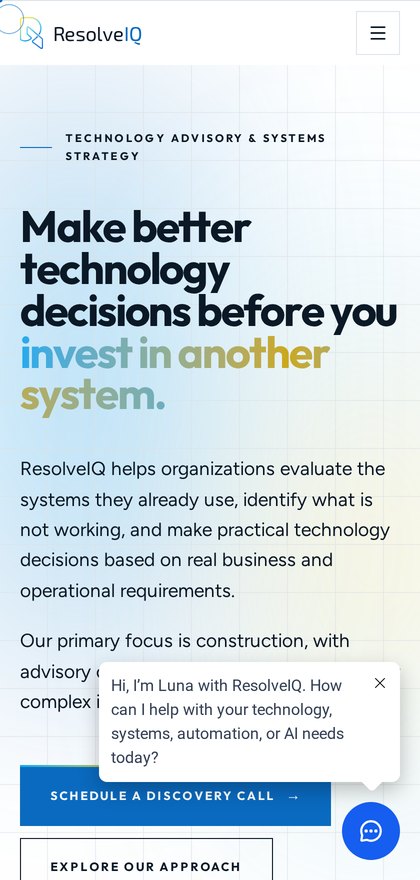
Cellara designed and developed the site as a single-purpose conversion surface rather than a general-purpose website.
The structure follows the buyer's questions in order. Position first, then the method, then who it helps, then why this firm, then the objections, then the call. Each section exists to move the reader one step closer to a decision, and any section that did not do that was cut.
Practical details were treated as part of the build, not as afterthoughts. Direct contact by phone and email is available on the page for buyers who prefer it, the primary action routes to a scheduled discovery conversation, and the required legal pages are in place.
The frequently asked questions section carries more weight than it usually does. For an advisory buyer, the objection is rarely the price. It is uncertainty about what they are committing to. Answering that in public shortens the sales cycle and improves the quality of the calls that do get booked.
Why This Matters Beyond Construction
The ResolveIQ engagement is a client story, but the underlying lesson applies to any service business considering new technology.
Software does not create clarity. It enforces whatever clarity already exists. A company with a defined process gets leverage from a new platform. A company without one gets a faster version of its existing confusion, plus a subscription.
This is the same principle behind how Cellara approaches revenue systems. Before an AI front desk, a follow-up sequence, or a CRM pipeline is built, the operating question has to be answered: what happens when an inquiry arrives, who owns it, how fast does it get answered, and how do we know. The system is the answer written down and made automatic.
For contractors specifically, the highest-return work is usually not the newest platform. It is closing the gap between an inquiry arriving and a human responding, then making the handoff from office to field reliable. Both are process decisions first.
Where ResolveIQ Fits
If a construction or contracting company is evaluating new software, recovering from an implementation that did not take, or trying to decide whether a process problem is really a technology problem, that is the moment ResolveIQ is built for.
The firm's work is deliberately narrow. Construction and general contracting is the primary focus, with additional capability in healthcare operations, and the engagement starts with the business rather than the product. Companies that want to be sold a platform will find it a poor fit. Companies that want the decision made correctly will not.
You can review the practice, the method, and the answers to common questions at resolveiq.biz, or request a discovery call directly.
Frequently Asked Questions
What does ResolveIQ do?
ResolveIQ is a technology advisory firm for construction and general contracting companies, with additional capability in healthcare operations. It helps companies clarify the business need, align a technology strategy to it, and implement with confidence, so software decisions are made against a defined problem rather than a feature list.
Why do construction technology implementations fail?
Usually because the business problem was never defined precisely enough for any tool to solve it. Construction work also happens in the field across many handoffs, so a system that assumes a desk, a stable connection, or one person remembering the process loses adoption quickly.
What is the difference between technology advisory and IT support?
IT support keeps existing systems running. Technology advisory decides what should exist in the first place, which platforms fit the operation, what sequence the work happens in, and who owns each step. Advisory happens before procurement.
Should a contractor fix its process or buy software first?
Process first. Software enforces whatever clarity already exists, so a company with a defined process gains leverage from a new platform, while a company without one gets a faster version of its current confusion plus a subscription.
Did Cellara Growth Co build the ResolveIQ website?
Yes. Cellara Growth Co designed and developed the ResolveIQ web presence, structured so the firm's position, method, audience, and objections are clear to a buyer before the first conversation.
How do I start a conversation with ResolveIQ?
ResolveIQ publishes a discovery call request on its site at resolveiq.biz, along with direct phone and email contact for buyers who prefer to reach out that way.
Sources
About the author
Krystal Gonzalez
Master of Science in Marketing, University of Colorado, with a specialization in high-tech entrepreneurial marketing.
Krystal Gonzalez leads revenue systems strategy at Cellara Growth Co, where answering, follow-up, reputation, and search systems for service businesses are designed, installed, and measured. Every Journal article is drawn from live client work and reviewed against primary sources before publication.